
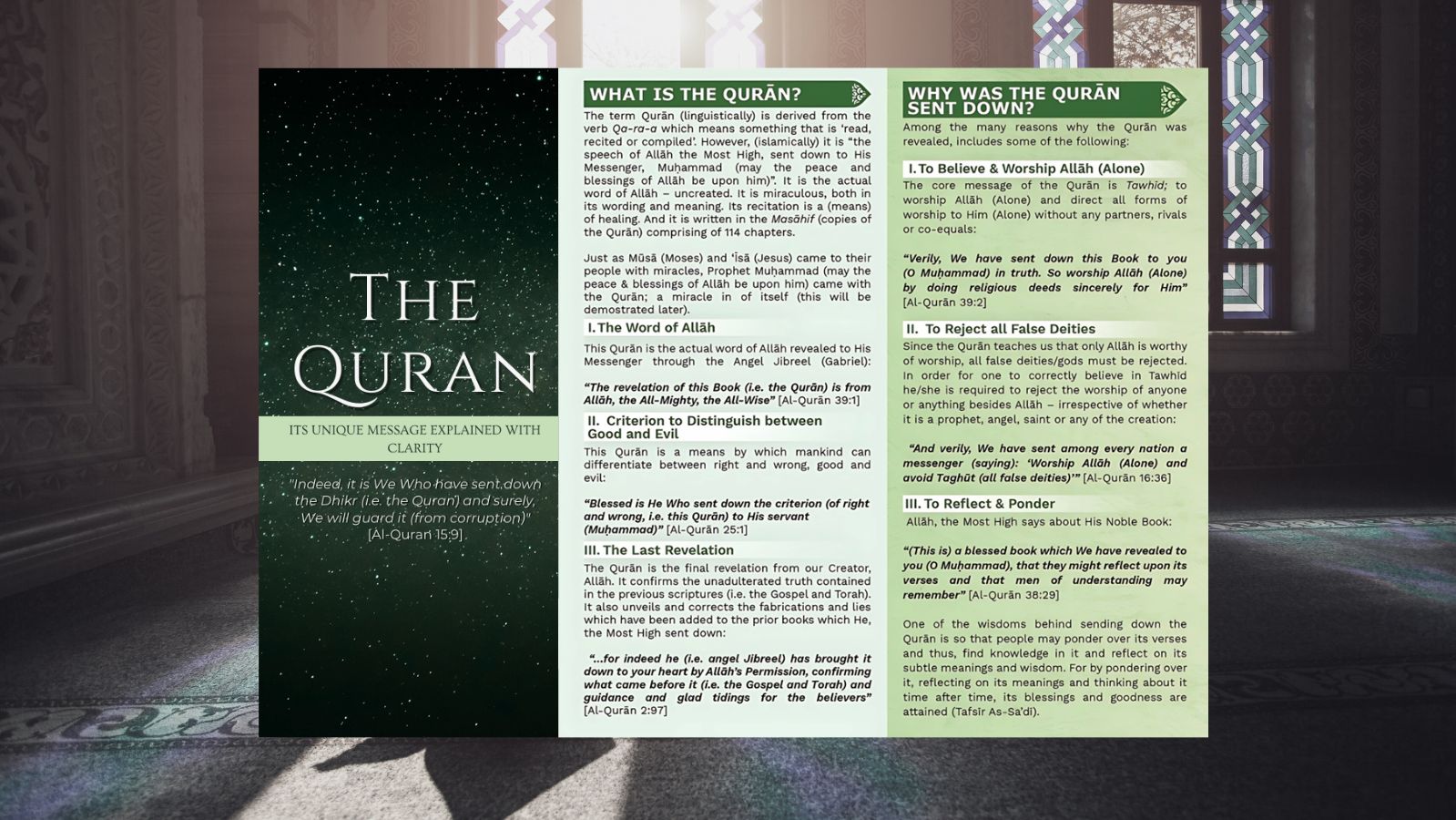
WHAT IS THE QUR’ĀN?
The term Qur’ān (linguistically) is derived from the verb Qa-ra-a which means something that is “read, recited or compiled”. However, (islamically) it is “the speech of Allāh the Most High, sent down to His Messenger, Muhammad (may the peace and blessings of Allāh be upon him)”. It is the actual word of Allāh – uncreated. It is miraculous, both in its wording and meaning. Its recitation is a (means) of healing. And it is written in the Mushāf (copies of the Qur’ān) comprising of 114 chapters.
Just as Mūsā (Moses) and ʿĪsā (Jesus) came to their people with miracles, Prophet Muhammad (may the peace & blessings of Allāh be upon him) also came with the Qur’ān; a miracle in of itself (this will be demonstrated later).
I. The Word of Allāh
This Qur’ān is the actual word of Allāh revealed to His Messenger through the Angel Jibreel (Gabriel):
“The revelation of this Book (i.e. the Qur’ān) is from Allāh, the All-Mighty, the All-Wise.”
— [Al-Qur’ān 39:1]
II. Criterion to Distinguish between Good and Evil
This Qur’ān is a means by which mankind can differentiate between right and wrong, good and evil:
“Blessed is He Who sent down the criterion (of right and wrong, i.e. this Qur’ān) to His servant (Muhammad).”
— [Al-Qur’ān 25:1]
III. The Last Revelation
The Qur’ān is the final revelation from our Creator, Allāh. It confirms the unadulterated truth contained in the previous scriptures (i.e. the Gospel and Torah). It also unveils and corrects the fabrications and lies which have been added to the prior books which He, the Most High sent down:
“…for indeed he (i.e. angel Jibreel) has brought it down to your heart by Allāh’s Permission, confirming what came before it (i.e. the Gospel and Torah) and guidance and glad tidings for the believers.”
— [Al-Qur’ān 2:97]
WHY WAS THE QUR’ĀN SENT DOWN?
Among the many reasons why the Qur’ān was revealed, includes some of the following:
I. To Believe & Worship Allāh (Alone)
The core message of the Qur’ān is Tawhīd; to worship Allāh (Alone) and direct all forms of worship to Him (Alone) without any partners, rivals or co-equals:
“Verily, We have sent down this Book to you (O Muhammad) in truth. So worship Allāh (Alone) by doing religious deeds sincerely for Him.”
— [Al-Qur’ān 39:2]
II. To Reject all False Deities
Since the Qur’ān teaches us that only Allāh is worthy of worship, all false deities/gods must be rejected. In order for one to correctly believe in Tawhīd he/she is required to reject the worship of anyone or anything besides Allāh – irrespective of whether it is a prophet, angel, saint or any of the creation:
“And verily, We have sent among every nation a messenger (saying): ‘Worship Allāh (Alone) and avoid Tāghūt (all false deities).’”
— [Al-Qur’ān 16:36]
III. To Reflect & Ponder
Allāh, the Most High says about His Noble Book:
“(This is) a blessed book which We have revealed to you (O Muhammad), that they might reflect upon its verses and that men of understanding may remember.”
— [Al-Qur’ān 38:29]
One of the wisdoms behind sending down the Qur’ān is so that people may ponder over its verses and thus, find knowledge in it and reflect on its subtle meanings and wisdom. For by pondering over it, reflecting on its meanings and thinking about it in time, after time, its blessings and goodness are attained (Tafsīr As-Saʿdī).
IV. To Teach us How to Lead a Wholesome Life
The Noble Qur’ān teaches us that mankind’s ultimate purpose in this life is to worship Allāh (Alone), directing all acts of worship solely to Him and living one’s life in accordance to the guidance revealed. In Islām, the word ibādah (worship) is a comprehensive term that encompasses all actions and sayings (both private or public) that Allāh loves and is pleased with. Thus, by performing what Allāh commands, a Muslim is worshipping his Creator, Allāh. The following verses are some examples of worship from the Noble Qur’ān:
To pray:
“O you who believe! Bow down, and prostrate yourselves, and worship your Lord and do good that you may be successful.”
— [Al-Qur’ān 22:77]
To be grateful to Allāh:
“And Allāh has brought you out from the womb of your mothers not knowing a thing, and He gave you hearing, sight and intellect that perhaps you may be grateful.”
— [Al-Qur’ān 16:78]
To give charity:
“…and spend in charity; that is better for yourselves. And whosoever is saved from the stinginess of his soul – then they are the successful.”
— [Al-Qur’ān 64:16]
To be just:
“And if you judge, judge between them with justice. Indeed, Allāh loves those who act justly.”
— [Al-Qur’ān 5:42]
To be patient:
“And be patient; verily, Allāh wastes not the reward of the good-doers.”
— [Al-Qur’ān 11:115]
To be truthful:
“And do not mix the truth with falsehood or conceal the truth while you know (it).”
— [Al-Qur’ān 2:42]