
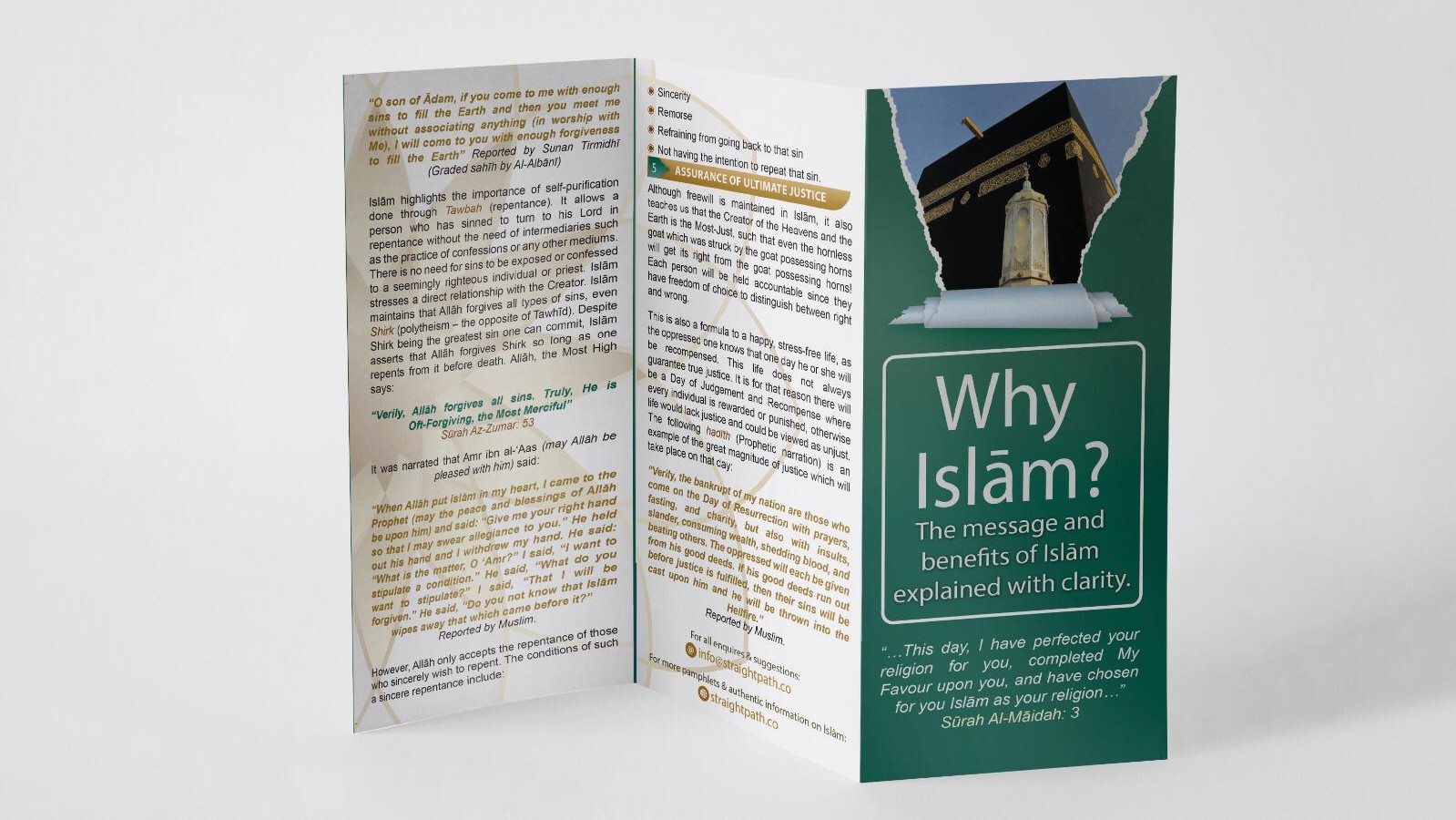
This pamphlet intends to discuss the general message of Islām as well as some of its key benefits that distinguish it from the other religions and faiths.
Islām comes from the Arabic root word As-la-ma, which means (linguistically) he submitted and surrendered.
However, islamically it means to submit oneself to the Creator with Tawhid (islamic monotheism), yield to Him with obedience and to renounce Shirk (polytheism) and its people.
The core message of Islām is Tawhid, the belief that Allāh is One with no partner or equal in:
1. His Lordship (rububiyyah): He (alone) is the Creator and Owner of all things that exist; and He (alone) manages their afairs.
2. His Divinity and Worship (uluhiyyah): which necessitates directing all acts of worship (e.g. prostration, supplication, sacrifice, vows, etc) only to Him.
3. His beautiful Names and lofty Attributes: which necessitates belief in all of His Names and Attributes as being complete and perfect.
“Lord of the heavens and the earth and whatever is between them – so worship Him (Alone) and be constant and patient in His worship. Do you know of any similarity to Him?”
Surah Maryam: 65
Note: The name Allāh will be used in place of God, as this is the name the Creator chose for Himself and encompasses all His beautiful names and attributes. It is translated to mean: the only deity worthy of worship.
- A clear understanding of the Creator
One of the distinguishing factors that sets Islām apart from other religions is its clear depiction of the Creator.
Islām strongly maintains that Allāh is perfect and complete, and therefore firmly rejects any belief or idea that denotes limitation and imperfection (e.g. trinity or having a son).
His perfection is summarised in the following chapter of the Noble Quran:
“Say (O Muhammad): ‘He is Allāh, (the) One. Allāh-us-Samad (The Self-Sufficient Master, whom all creatures need). He begets not, nor was He begotten; And there is none co-equal or comparable unto Him” Surah Al-Ikhlās: 1-4
“He is the One and unique, to whom alone belongs the utmost perfection. They (the creation) are in utmost need of Him and turn to Him regarding that which concerns them. From His perfection He bears not, nor was He born, because He is completely independent of (all) needs. And there is none co-equal or comparable to Him either in His names, attributes or actions – blessed and exalted be He (Tafsir As-Sa’dī).
- A close and personal relationship with the Creator
Islām views an individual’s close and personal relationship with his Creator as an integral part for achieving everlasting happiness in this life.
It advocates for the believer to have sustained consciousness of his or her Creator.
Allāh, the Most High says: “Verily, in the remembrance of Allah do hearts find rest” Surah Ar-Rad: 28
Islām teaches that a connection with the Creator is the source of happiness and that true happiness is measured by the strength of one’s connection with his Lord.
A person may achieve this by following the Creator’s guidance and thereby attain internal peace and tranquility. On the contrary, seeking everlasting happiness by accumulating materialistic gains such as money, cars and other worldly desires is not the answer nor will it ever fill the void that a person feels.
This emptiness can only be satisfied by submitting oneself to the worship of his Creator, Allāh.
- A positive view on life
Islām gives an optimistic perspective on life for a person such that even the harm received from a prick of a thorn is considered as an expiation of sins!
The Prophet of Allāh (may the peace and blessings of Allah be upon him) said: “There is no calamity that befalls a Muslim but Allāh expiates (sin) thereby, even a thorn that pricks him” Reported by Bukhārī & Muslim.
“Amazing is the afair of the believer, verily all of his affair is good and this is not for no oneexcept the believer. If something good happens to him, he is grateful and that is good for him. If something of harm befalls him he is patient and that is good for him” Reported by Muslim.
In short, Islām considers any misfortune (e.g losing a child or a loved one) that befalls a Muslim as a means of expiation of sins which he or she will be rewarded for provided that they are patient. Islām views this as a formula for a happy and content life.
- Forgiveness of sins
Forgiveness is one of the key benefits in Islām, such that Allāh forgives all types of sins – even the greatest sin a person can think of!
The Prophet of Allāh, Muhammed (may the peace and blessings of Allah be upon him) said: “O son of Adam, if you come to me with enough sins to fill the Earth and then you meet me without associating anything (in worship with Me), I will come to you with enough forgiveness to fill the Earth” Reported by Sunan Tirmidhi (Graded sahih by Al-Albānī)
Islām highlights the importance of self-purification done through Tawbah (repentance).
It allows a person who has sinned to turn to his Lord in repentance without the need of intermediaries such as the practice of confessions or any other mediums.
There is no need for sins to be exposed or confessed to a seemingly righteous individual or priest. Islām stresses a direct relationship with the Creator.
Islām maintains that Allāh forgives all types of sins, even Shirk (polytheism – the opposite of Tawhid). Despite Shirk being the greatest sin one can commit, Islām asserts that Allāh forgives Shirk so long as one repents from it before death. Allāh, the Most High says: “Verily, Allāh forgives all sins. Truly, He is OftForgiving, the Most Merciful” Surah Az-Zumar: 53
“When Allāh put Islām in my heart, I came to the Prophet (may the peace and blessings of Allah be upon him) and said: “Give me your right hand so that I may swear allegiance to you.” He held out his hand and I withdrew my hand. He said: “What is the matter, O ‘Amr?” I said, “I want to stipulate a condition.” He said, “What do you want to stipulate?” I said, “That I will be forgiven.” He said, “Do you not know that Islām wipes away that which came before it?” Reported by Muslim.
It was narrated that Amr ibn al-‘Aas (may Allah be pleased with him) said: However, Allāh only accepts the repentance of those who sincerely wish to repent. The conditions of such a sincere repentance include:
- Sincerity
- Remorse
- Refraining from going back to that sin
- Not having the intention to repeat that sin
- Assurance of ultimate justice
Although freewill is maintained in Islām, it also teaches us that the Creator of the Heavens and the Earth is the Most Just, such that even the hornless goat which was struck by the goat possessing horns I will get its right from the goat possessing horns!
Each person will be held accountable since they have freedom of choice to distinguish between right and wrong. This is also a formula to a happy, stress-free life, as the oppressed one knows that one day he or she will be recompensed. This life does not always guarantee true justice.
It is for that reason there will be a Day of Judgement and Recompense where every individual is rewarded or punished, otherwise life would lack justice and could be viewed as unjust.
The following hadith (Prophetic narration) is an example of the great magnitude of justice which will take place on that day: “Verily, the bankrupt of my nation are those who come on the Day of Resurrection with prayers, fasting, and charity, but also with insults, slander, consuming wealth, shedding blood, and beating others. The oppressed will each be given from his good deeds. If his good deeds run out before justice is fulfilled, then their sins will be cast upon him and he will be thrown into the Hellfire.” Reported by Muslim